Microwave Repair for Built-In, Over-the-Range & Countertop Units
When the plate spins but the food stays cold, we trace the fault and tell you straight whether it pays to fix.
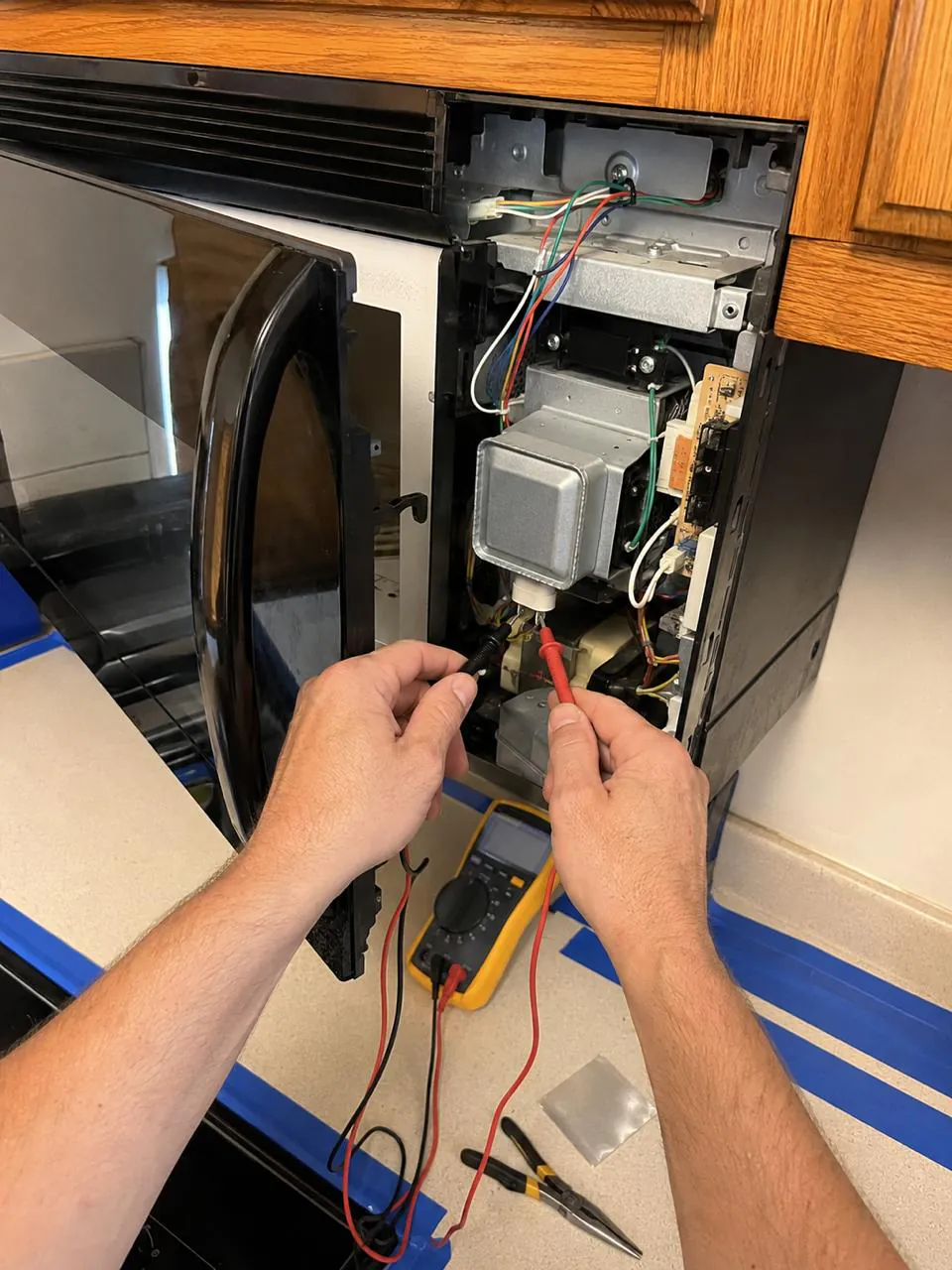
A microwave is the appliance nobody thinks about until the morning it hums, lights up, and leaves the coffee stone cold. Because so much of modern cooking leans on that two-minute reheat, a dead unit throws off the whole rhythm of a kitchen — especially when it is an over-the-range model that also doubles as your cooktop vent and stove light. Encinitas Appliance Repair Service treats microwaves as the precision, high-voltage appliances they actually are, not as throwaway boxes, and we service every form factor: countertop, over-the-range (OTR), built-in wall units, microwave drawers, and combination wall ovens with a microwave on top. What sets microwave work apart from the rest of the kitchen is the capacitor. Inside the cabinet sits a high-voltage capacitor that can hold a dangerous charge long after the unit is unplugged, which is exactly why a no-heat microwave is the wrong appliance to poke around in over a YouTube video. Our technicians discharge that capacitor and follow proper test procedures before a single component is touched. That same caution is why our advice is honest: for a $90 countertop unit, replacement is often smarter, but for a $700 built-in framed into custom cabinetry or a flush over-the-range model matched to your hood and backsplash, a repair usually saves you the cost and headache of refitting the whole space. We cover homes throughout San Diego County and Orange County from our Encinitas base — coastal towns, inland valleys, and everywhere between. Phones are answered around the clock, jobs are scheduled daily between 8:00 AM and 6:00 PM, and same-day slots are frequently available. You will get a clear $89 diagnostic and a firm flat-rate price before we lift a tool, so there are never surprises stacked onto the bill.
What a microwave actually does when it heats — and why that matters for the repair
Understanding why your microwave failed starts with how it works. A transformer steps household voltage up to several thousand volts, a high-voltage capacitor and diode store and rectify that charge, and the magnetron converts it into the microwave energy that excites water molecules in your food. A spinning turntable (or a stirrer fan in flatbed models) keeps the heating even, while a set of interlock door switches guarantees the magnetron can never fire with the door open. That chain is why a microwave so often presents one clean symptom: it lights up, the fan runs, the plate turns — but nothing gets hot. When every visible sign of life is normal yet the food stays cold, the fault is almost always in the high-voltage circuit: a failed magnetron, an open diode, a tired capacitor, or a thermal cutout that has tripped. We test each link in that chain rather than swapping parts on a hunch, which keeps your flat-rate honest and the repair durable. The interlock switches deserve their own mention because they are the most common reason a microwave 'won't start' at all. There are usually three of them, stacked behind the door latch, and they must close in the right sequence. A single worn switch — cheap in itself — can make an expensive unit look dead. Diagnosing which link in the safety chain has broken is exactly the kind of pinpoint work that separates a lasting repair from a parts-cannon guess.
Over-the-range microwaves: the model that does three jobs at once
Over-the-range units are the workhorses of the category and, predictably, the ones we are called out to most. They mount above the cooktop, vent steam and smoke through either a recirculating charcoal filter or an external duct, and provide a cooktop light — so when an OTR fails, you can lose your microwave, your range hood, and your stove lighting in a single stroke. Heat and grease rising from the burners below are hard on these units, which is why their exhaust fan motors, grease filters, and membrane touchpads wear faster than those on a countertop model. Weight and mounting make OTR repair its own discipline. These units hang from a wall bracket and bolt up through the cabinet above, so safely lowering one to reach the magnetron or control board is a two-person job done right. We come prepared for that. Common OTR-specific complaints we resolve include a vent fan that runs constantly or not at all, a cooktop light that won't turn off, a charcoal filter that has stopped clearing odors, and a door that sags or won't latch after years of being slammed shut with one hand full of groceries. Whipool, GE, and Samsung dominate the over-the-range space, and each has its quirks. Samsung OTR models are prone to a known SE / 5E touchpad error caused by a failing membrane keypad or control board, which we replace with the corrected part rather than the original. GE and Whirlpool units more often surface mechanical issues — fan motors, door switches, and grease-laden interlocks — that respond well to a thorough clean and the right replacement component.
Built-in and drawer microwaves: protecting the cabinetry, not just the box
Built-in microwaves — whether framed into a wall with a trim kit, stacked above a wall oven, or fitted as a pull-out drawer beneath the counter — are where repair almost always beats replacement. The unit is fitted to a specific cabinet opening and trim kit, so swapping brands or even models can mean a carpentry project, a new filler panel, and a mismatched finish next to the rest of your kitchen. Keeping the original unit alive keeps your kitchen looking deliberate. Microwave drawers, popular in island and peninsula layouts from KitchenAid, Sharp, and Bosch, bring their own failure modes. The motorized drawer mechanism, the touch controls along the top edge, and the sensor that confirms the drawer is fully closed all take daily abuse. We repair drawers that won't open or close, panels that have gone unresponsive, and the open/close motor assemblies that eventually wear out. Sharp essentially invented the microwave drawer and still builds many sold under other badges, so its mechanisms are familiar territory for our techs. Built-in wall units from Café, KitchenAid, Bosch, and GE Monogram share premium control boards and convection elements (in microwave-convection combos) that justify a proper diagnosis. A convection combo that microwaves fine but won't bake usually points to the convection element or its relay rather than the high-voltage side — a distinction that saves you from paying for the wrong fix. We carry or source the manufacturer-grade boards and elements these units need so the repair holds and your warranty stays intact.
The repair-or-replace call: when we tell you to buy a new one
Honesty is the whole business here, so we will say plainly when a repair doesn't make sense. The economics turn on the magnetron and the unit's value. A new magnetron plus labor can approach the price of a fresh countertop microwave, so on an inexpensive portable unit we will usually recommend replacement and not charge you to chase a losing repair. You only ever pay the $89 diagnostic to know for certain. The math flips hard the other direction for anything built in. An over-the-range or wall-built microwave that costs several hundred dollars to replace — before you account for a possible cabinet refit — is well worth a magnetron, a control board, or a door assembly. The same goes for premium drawer and combination units, where the replacement and re-fitting cost dwarfs almost any single repair. In those cases we fix it, and we use genuine manufacturer-grade parts so it lasts. Age factors in too. Microwaves typically run 9 to 10 years, and a no-heat fault in year three is a very different conversation from one in year twelve. We weigh the part cost, the unit's value, its age, and the cabinetry around it, then give you a recommendation we would stand behind in our own kitchen. There is never pressure either way — just the numbers and a straight answer.
Sparking, arcing, and burning smells: stop using it and call
If your microwave crackles, throws sparks, or arcs with a light show inside the cavity, switch it off and book a diagnosis before you run it again. Arcing is not just alarming; it can burn through the cavity wall and ruin an otherwise healthy unit. The good news is that the cause is frequently inexpensive: a worn or burned waveguide cover (the small mica or plastic panel on the cavity wall), a chipped or peeling interior coating, a stray metal-trimmed dish, or a damaged rack support. A burning smell or visible scorching changes the calculus and the urgency. That can signal a failing magnetron, an overheating diode, or a stack of arc damage that has spread, and continuing to run the unit risks turning a modest repair into a write-off. We assess the cavity, the waveguide, and the high-voltage components, then tell you whether it's a quick mica-cover swap or something deeper. Door and seal issues sit in this same safety conversation. A door that no longer closes flush, a cracked door panel, or a damaged seal can affect how well the cabinet contains microwave energy, which is why a sagging or sparking door is something we treat as a do-not-delay repair rather than a cosmetic nuisance. Panasonic units, which use a flatbed inverter design instead of a turntable, have their own arc-prone points around the cavity floor that we know to inspect.
Brand-by-brand: the nuances we plan for before we arrive
We service all major brands, and knowing each one's tendencies lets us arrive with the right parts and a head start on the diagnosis. Samsung OTR models are notorious for the SE/5E membrane keypad fault; LG units pack inverter and 'NeoChef' smart-inverter boards that need a careful read of the error code rather than a blind board swap. Whirlpool and its Maytag and Amana siblings share a sturdy, repairable platform where door switches, magnetrons, and fan motors are the usual suspects, and parts are widely available. GE — along with its Café and Monogram premium lines — leans on control boards and door interlocks, with the higher-end built-ins adding convection elements to the diagnostic checklist. KitchenAid and Bosch built-ins and drawers share quality mechanical assemblies; their drawer motors and trim-kit fitment are where our experience pays off. Frigidaire countertop and OTR units are budget-friendly and often tip the repair-or-replace math toward replacement on cheaper models, while their built-ins are worth saving. Panasonic and Sharp round out the list with the most distinctive engineering. Panasonic's inverter and flatbed designs deliver even heating without a turntable but route their high-voltage path differently, so we test them accordingly. Sharp, the inventor of the microwave drawer, builds reliable drawer and countertop units whose mechanisms and panels we know inside out. Whatever badge is on your door, we match the genuine part to the exact model and serial so the fix is correct the first time.
Booking, pricing, and what to expect on the visit
Getting started is simple: call us — the phone is answered 24/7 — or use our online booking link to lock in a time. Jobs are scheduled daily from 8:00 AM to 6:00 PM, and because a kitchen without a working microwave disrupts the whole day, same-day appointments are often available when you reach us early. We cover the full sweep of San Diego County and Orange County from Encinitas, so coastal, inland, and OC addresses are all on our map. The pricing is built to be transparent. A flat $89 service call covers the technician's visit and a complete diagnosis. Once we have identified the fault, you receive a firm, flat-rate quote for the repair before any work begins — not an hourly meter, and not a vague estimate that balloons. Any starting prices you see listed are just that: opening estimates that the on-site flat rate replaces. You approve the number first; we work second. On the visit itself, the technician will safely discharge the high-voltage capacitor, test the door switches, magnetron, diode, and control board as needed, and either complete the repair on the spot when the part is on the truck or order the correct manufacturer-grade component for a quick return. For over-the-range and built-in units we handle the safe removal and remounting as part of the job. You will leave the appointment knowing exactly what was wrong, what it cost, and whether — in our honest judgment — fixing was the right move.
Common microwave problems we fix
- Runs and lights up but won't heat the food
- Sparking or arcing inside the cavity
- Dead touchpad or unresponsive buttons (including Samsung SE/5E errors)
- Door won't latch or the unit won't start
- Turntable not turning or grinding
- Over-the-range vent fan or cooktop light stuck on or not working
- Loud humming, buzzing, or rattling during operation
- Microwave drawer that won't open, close, or respond
Microwave Repair — FAQ
Why does my microwave run and light up but not heat the food?
A microwave that runs but won't heat almost always has a high-voltage fault rather than a control problem. When the plate spins and the panel lights yet food stays cold, the failure is usually a burned-out magnetron, an open diode, a tired capacitor, or a tripped thermal cutout. We safely discharge the capacitor and test each link, then give a flat-rate quote after the $89 diagnosis.
My microwave is sparking and arcing inside — is it safe to keep using?
No, stop using it and book a diagnosis before you run it again, because arcing can burn through the cavity wall and ruin an otherwise healthy unit. The cause is often inexpensive, like a worn waveguide cover, chipped interior coating, a metal-trimmed dish, or a damaged rack support. Caught early it's a quick fix; left running it can become a write-off.
Is it cheaper to repair or replace a microwave?
Replace cheap countertop units and repair built-in or over-the-range models. A new magnetron plus labor can approach the price of a fresh portable microwave, so we'll honestly steer you to replace an inexpensive unit. But built-in, drawer, and over-the-range models cost far more to swap out and re-fit cabinetry, so repairing them almost always wins. The $89 diagnostic tells you exactly which side of the line you're on.
Do you fix over-the-range microwaves, not just countertop ones?
Yes, we repair over-the-range, built-in, drawer, and countertop microwaves across San Diego and Orange County. We fix vent fans stuck on or off, cooktop lights that will not turn off, dead touchpads, sagging doors, and no-heat faults after a safety-first diagnosis. You approve the flat-rate repair price before work begins.
Why won't my microwave start even though it has power?
The most common cause is a worn door interlock switch in the latch assembly. Microwaves use a stack of usually three door switches that must close in the right sequence before the unit will run, so a single failed switch makes an expensive appliance look completely dead. We diagnose exactly which switch broke instead of swapping parts on a hunch, then quote a firm flat rate.
What brands of microwave do you repair?
We service all major brands, including Samsung, LG, Whirlpool, GE, Panasonic, Frigidaire, KitchenAid, Bosch, Café, Maytag, Sharp, and Amana. Knowing each brand's tendencies lets us arrive prepared — Samsung over-the-range units are prone to the SE/5E touchpad fault, LG uses smart-inverter boards that need a careful error-code read, and Panasonic's flatbed inverter design routes high voltage differently. We match the genuine OEM part to your exact model and serial.
How much does a microwave repair cost?
Every visit starts with a flat $89 service call that covers the technician's trip and a complete diagnosis. Once we've pinpointed the fault, you get a firm flat-rate quote for the repair before any work begins — not an hourly meter and not an estimate that balloons. You approve the price first, and we work second, so there are never surprises stacked onto the bill.
How soon can a technician come out?
Same-day appointments are often available, especially when you call early. Our phone at (760) 477-0575 is answered 24/7, and jobs are scheduled daily from 8:00 AM to 6:00 PM across San Diego County and Orange County. Because a kitchen without a working microwave throws off the whole day, we prioritize getting you a quick slot. Call or use the online booking link to lock in a time.
My microwave turntable isn't spinning — can that be fixed?
Yes, a turntable that won't turn or grinds is usually a simple, affordable repair. The cause is typically a failed turntable motor, a worn drive coupler, or debris jamming the roller ring beneath the glass tray. We confirm the exact part, quote a flat rate, and often complete the fix on the spot when the component is on the truck — using genuine OEM parts so it lasts.
My microwave drawer won't open or respond — do you repair those?
Yes, we repair microwave drawers from KitchenAid, Sharp, Bosch, and other brands. Drawer units take daily abuse on the motorized open/close mechanism, the touch controls along the top edge, and the sensor that confirms the drawer is fully closed. We fix drawers that won't open or close, unresponsive panels, and worn motor assemblies, sourcing the manufacturer-grade parts these premium units need.
How long should a microwave last before it's worth replacing?
Microwaves typically run 9 to 10 years, so a no-heat fault in year three is a very different conversation from one in year twelve. We weigh the part cost, the unit's value, its age, and the cabinetry around it before giving a recommendation we'd stand behind in our own kitchen. There's never pressure either way — just the numbers and a straight answer after the $89 diagnosis.
Do you use genuine parts, and are your technicians trustworthy?
Yes, we use genuine OEM parts matched to your exact model and serial, and every technician is background-checked. Manufacturer-grade boards, magnetrons, switches, and door assemblies keep the repair durable and protect your warranty, especially on premium built-in and drawer units. We are an appliance repair company serving San Diego and Orange County, and we quote a firm flat rate before any work begins.
More on microwave repair
My over-the-range microwave's vent fan and cooktop light died along with it — can one repair fix all three?
Yes, all three usually trace back to a single over-the-range failure that one repair resolves. Because an OTR unit doubles as your range hood and stove light, a failed control board or interlock can knock out heating, venting, and lighting at once. Heat and grease from the burners below wear the fan motor, filters, and touchpad fastest. We safely lower the unit, pinpoint the fault, and quote a flat rate after the $89 diagnosis.
Will the $89 microwave service call get added on top of my repair price, or is the quote all-in?
The repair quote is all-in and firm, given before any work starts — no hourly meter and no estimate that creeps upward. The flat $89 service call covers the technician's trip and a full on-site diagnosis, and once we find the fault you approve one flat-rate price for the fix. Any starting price listed online is just an opening estimate that the on-site flat rate replaces. We use genuine OEM parts.
Which towns across San Diego and Orange County can I get a microwave technician sent to?
We cover the full sweep of San Diego County and Orange County from our Encinitas base, including coastal towns, inland valleys, and OC addresses alike. The same-day-friendly crew handles countertop, over-the-range, built-in, and drawer microwaves for every neighborhood on that map. Our phone at (760) 477-0575 is answered 24/7, jobs run daily from 8:00 AM to 6:00 PM, and background-checked techs carry genuine OEM parts.
Need Fast, Reliable Appliance Repair?
Book online in minutes and get back to what matters most.
Microwave repair reviews
Built-in and over-the-range microwaves need safe diagnosis around high-voltage parts, mounting and ventilation.
Our over-the-range microwave ran but would not heat. They explained the safety side clearly and tested the likely components before recommending repair.
The built-in trim kit made replacement look impossible. The technician removed it carefully and left the cabinet lines clean.
We had sparking inside the microwave. They found the damaged waveguide cover, checked the cavity and told us when repair still made sense.
The turntable and fan were acting strange together. They traced it to a switch issue instead of blaming the whole control panel.
I liked that they were honest about repair versus replacement on a lower-cost unit. We did not feel pushed either way.
The appointment was quick, clean and safe. For a microwave, that last part matters more than people realize.