Refrigerator & Freezer Repair Across San Diego and Orange County
When the cooling quits, the clock starts — we hold same-day slots so your food and your day survive the warm spell.
A refrigerator is the one appliance in your home that never gets a day off, and the only one whose failure can spoil hundreds of dollars of groceries before dinner. That is why we treat a warm fridge or a thawing freezer as the emergency it is, reserving same-day appointments for refrigeration calls and rolling out with the fast-movers — fans, thermostats, start relays, defrost parts and door gaskets — already stocked on the truck. Our technicians work on every configuration coastal and inland kitchens throw at us: top-freezer and bottom-freezer units, French-door and side-by-side models, counter-depth fridges, built-in and panel-ready columns, standalone upright and chest freezers, beverage centers, and the integrated systems that disappear into custom cabinetry. We diagnose the actual root cause rather than swapping parts on a hunch, then quote one flat rate before touching a screwdriver. From the beach blocks of Encinitas, Del Mar and La Jolla to inland Escondido, El Cajon and Santee, and north into Irvine, Newport Beach and Anaheim, we cover the two counties with one promise: an honest diagnosis, genuine manufacturer-grade parts, and a repair that lasts. Phones are answered around the clock; repairs are scheduled daily between 8:00 AM and 6:00 PM.
Why your refrigerator stops cooling
When a fridge runs but won't get cold, the compressor is rarely the first suspect — though it gets blamed the most. Far more often the trouble is air, not refrigerant. A failed evaporator fan stops circulating cold air from the freezer side into the fresh-food compartment, so the freezer stays icy while the upper section drifts warm. A jammed or iced-over defrost system buries the evaporator coils in frost until air can no longer pass through them. A stuck damper, a tired thermistor, or a confused control board can each leave the cabinet warmer than it should be. We diagnose cooling loss in a deliberate order: temperatures at multiple points, airflow at the vents, frost patterns on the coils, the defrost heater and thermostat, the fans, the sealed-system pressures and, only then, the compressor and start components. That sequence matters because a $40 fan or a $30 defrost thermostat is a very different conversation than a sealed-system repair — and you deserve to know which one you're actually facing before you commit a dollar. Sealed-system failures do happen, especially a refrigerant leak or a compressor that won't start. On these we are candid about cost versus value, because pouring a major repair into an aging budget fridge rarely makes sense, while the same repair on a high-end built-in almost always does.
Ice makers, water lines and dispensers
Ice makers are the single most common refrigerator complaint we see, and the good news is that most failures are mechanical or hydraulic rather than catastrophic. A no-ice fridge usually traces back to a frozen fill tube, a faulty water inlet valve, a clogged or saturated water filter, a kinked supply line, or a worn-out icemaker module that no longer cycles. Samsung French-door models are notorious for ice buildup behind the fresh-food panel that eventually chokes the fan, while many LG units fail at the icemaker's bail arm or optical sensor. Water and filtered-dispenser problems follow a similar logic. Low or no water flow points to a clogged filter, a failing dispenser valve, or a line that froze where it runs through the door. Leaks at the dispenser often come from a cracked tank or a perished line fitting. We test the inlet valve, flush and check the lines, verify the filter housing seals, and confirm the dispenser actuator and switch all do their jobs before we hand the kitchen back. Because much of our inland service area runs hard water, mineral scale shortens the life of valves, filters and tanks faster than the manuals predict. Where that's the cause, we say so and fix the underlying issue rather than just clearing the symptom.
Leaks, frost and the defrost system
Water under or inside a refrigerator is almost never the fridge 'sweating' — it's a fault with a specific, findable cause. The most common is a clogged defrost drain: melt-water from the automatic defrost cycle can't escape, so it overflows into the compartment or pools beneath the unit, sometimes freezing into a sheet under the crisper drawers. A cracked or disconnected water line, a failed inlet valve, or a door that no longer seals can each leave a puddle too. Frost problems split into two groups. Heavy frost only in the freezer usually means the automatic defrost system has quit — a failed defrost heater, defrost thermostat, or the control timer or board that runs the cycle. Frost or condensation in the fresh-food section, by contrast, points to a damper, a door-seal leak, or warm humid air sneaking in past a tired gasket. We trace which it is, clear or rebuild the defrost path, and replace the worn component rather than thawing it once and hoping. Door gaskets deserve a mention of their own. A gasket that's gone stiff, torn or magnetized-out-of-shape forces the compressor to run nearly nonstop, drives up your energy bill, and invites condensation and frost. Replacing one is a modest repair that often pays for itself in efficiency alone.
Strange noises, short-cycling and the compressor
Refrigerators are supposed to hum quietly, so a new noise is your appliance telling you something. A loud buzz or rattle frequently comes from the condenser or evaporator fan motor, or from a fan blade ticking against built-up ice. A rhythmic clicking every few minutes is the classic sign of a compressor trying and failing to start — usually a bad start relay or capacitor rather than a dead compressor itself, which is a far cheaper fix when caught early. A gurgle or occasional pop is normal refrigerant flow and nothing to worry about. Short-cycling — the compressor switching on and off too frequently — and constant running are two sides of the same coin: the system can't reach or hold its target temperature. Dirty condenser coils are a leading and often-overlooked cause, especially in homes with pets, where a thick blanket of dust insulates the coils and makes the compressor work itself toward an early grave. Failing thermostats, relays, control boards and door seals round out the usual list. We pull and read the actual symptoms instead of guessing. When the compressor genuinely has failed, we'll tell you plainly, weigh it against the age and class of the unit, and never push a sealed-system repair that doesn't make financial sense for you.
Brands we service — mainstream to luxury
Our technicians are trained across the full spectrum of refrigeration, and the brand on the door changes how we approach the job. Sub-Zero built-ins, with their dual-compressor designs and magnetic door seals, demand model-specific knowledge and genuine parts — we honor that engineering rather than improvising. Viking, Thermador, Monogram, JennAir, Café, Dacor and Fisher & Paykel columns and panel-ready units get the same careful, manufacturer-correct treatment, including re-aligning panels and seals so the unit stays flush in the cabinetry. On the mainstream side, Samsung and LG bring sophisticated electronics, twin-cooling and digital-inverter compressors, and well-documented quirks — Samsung's fan-icing and LG's linear-compressor and sensor issues among them — that we diagnose every week. Whirlpool, GE, KitchenAid, Frigidaire, Maytag, Amana, Kenmore, Electrolux and Bosch make up the bulk of American kitchens, and we carry or quickly source the genuine parts each requires. European Miele and Bosch refrigeration get the precise, spec-driven service their tolerances expect. Whatever the badge, we use manufacturer-grade parts that protect any remaining warranty and keep the repair durable. If a unit is rare or the part is unusual, we'll tell you the lead time honestly up front rather than after the fact.
Freezers, chest units and beverage centers
Freezers fail differently than refrigerators, and we service the full range — built-in freezer columns, standalone uprights, garage and chest freezers, drawer freezers, wine coolers and beverage centers. A freezer that won't stay frozen most often has a frosted-over evaporator coil from a dead defrost component, a struggling compressor or start relay, or a door seal that's letting warm air seep in. Garage freezers in our hotter inland zones work especially hard in summer, and a marginal compressor or seal that coped in spring can give out in July. Chest freezers are mechanically simpler but still vulnerable to thermostat failure, lid-gasket leaks and drainage problems. Wine and beverage centers, on the other hand, are temperature-sensitive precision units where a few degrees of drift can ruin a collection — these usually come down to a thermoelectric module or compact compressor, a fan, or a control board, all of which we diagnose and repair. When a freezer fails, time and food are on the line, so we prioritize these calls the same way we do refrigerator outages — same-day where the schedule allows, with the common defrost and start components already on board.
Our diagnosis, pricing and same-day service
Every refrigerator job starts the same way: an $89 service call that covers a full, methodical diagnosis. From there you get one firm flat-rate quote for the repair before any work begins — no hourly meter, no surprises tacked on at the end, and no pressure. Listed starting prices are estimates only; the real number depends on what we find, and you approve it first. Because refrigeration failures spoil food fast, we hold daily slots specifically for cooling emergencies, and same-day service is often available when you call early. Phones are answered 24/7, and repairs are scheduled every day between 8:00 AM and 6:00 PM across San Diego and Orange County. You can reach us by phone or book your visit through our online booking link, whichever you prefer. We back our work with genuine, manufacturer-grade parts and a straightforward repair-or-replace recommendation. A modern refrigerator typically lasts 13 to 15 years, and high-end built-ins far longer, so most repairs are well worth making — but if yours isn't, we'll say so honestly rather than sell you a fix that doesn't pay off.
Common refrigerator problems we fix
- Refrigerator running but not cooling, or freezer warm while fridge stays cold
- Water pooling under the unit or freezing under the crisper drawers
- Ice maker not producing, dispensing, or leaking water
- Heavy frost buildup or a failed automatic defrost cycle
- Compressor clicking, short-cycling, or running constantly
- Loud buzzing, rattling, or humming from the fans or compressor
- Torn or worn door gasket causing condensation and high energy use
- Dispenser giving no water or low flow from a clogged or frozen line
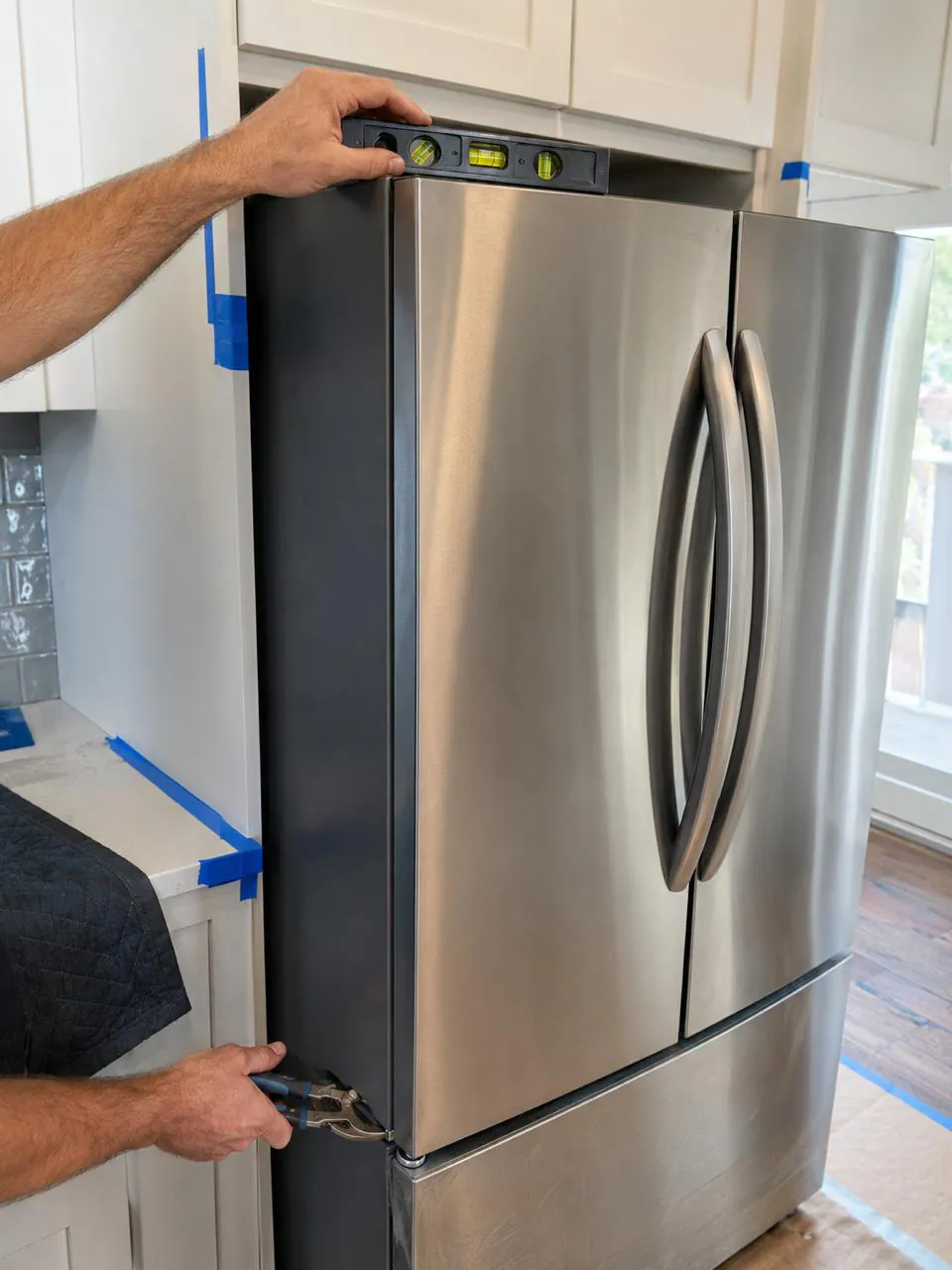
A recent refrigerator repair
Real refrigerator repair in a San Diego–area home.
Refrigerator Repair — quick answers
- Do you repair built-in and counter-depth refrigerators too?
- Yes, Encinitas Appliance Repair Service repairs French-door, side-by-side, counter-depth, and built-in column refrigerators across San Diego County and Orange County. We diagnose cooling failures, sealed-system issues, water leaks, ice maker problems, noisy fans, bad relays, and door-seal faults. The $89 service call covers an on-site diagnosis, then you approve a firm flat-rate repair quote before work begins.
- Will my factory warranty stay valid if you fix my fridge?
- Yes, we protect any remaining manufacturer warranty by repairing your refrigerator only with genuine OEM parts. Generic aftermarket components can void coverage and rarely match the tolerances of compressors, inlet valves and control boards. Our background-checked technicians source the correct manufacturer-grade part for your exact model, give you one flat-rate price up front, and answer the phone 24/7 at (760) 477-0575 to schedule.
- Can you service the integrated panel-ready refrigerators in newer San Diego custom kitchens?
- Yes, we repair both the integrated panel-ready columns common in new-build coastal kitchens and the older standalone fridges in established homes. New built-ins demand model-specific knowledge and careful panel and seal re-alignment so the unit sits flush in custom cabinetry, while aging units often need defrost, gasket or relay work. The $89 diagnosis identifies the true fault on either, and you approve a flat rate before we start.
Refrigerator Repair — FAQ
My refrigerator stopped cooling but the light still works — what's wrong?
A fridge that hums and lights up but turns warm is almost always an airflow or defrost problem, not a dead compressor. Picture a coastal kitchen where humid air ices the evaporator coil, or where the evaporator fan quits and stops pushing cold up from the freezer. Our $89 service call pinpoints the exact part, and you hear one flat-rate price before we begin.
Can you repair my refrigerator the same day?
Same-day refrigerator visits are frequently open, especially if you reach us early. Heat is unforgiving on a stalled fridge here, so we keep daily refrigeration slots and ride out with fans, thermostats, start relays and gaskets already aboard. Someone picks up at (760) 477-0575 around the clock, and we run appointments from 8am to 6pm every day across San Diego and Orange County.
Why is there water pooling under my refrigerator?
Pooling water nearly always traces to a blocked defrost drain rather than the cabinet sweating. As the automatic defrost cycle melts frost, that water has no exit, so it spills below the unit or freezes into a sheet under the crispers. In our humid coastal homes a tired door gasket, cracked supply line or failed inlet valve can add to it. We locate the true source and stop the leak for good.
My ice maker stopped making ice — is that a hard fix?
An ice maker that goes quiet is usually a small mechanical or water-flow fault, not a heavy repair. The usual suspects are a frozen fill tube, a bad water inlet valve, a saturated filter, or a module that no longer cycles. Inland scale from our hard water shortens valve life too. Samsung French-door units ice up behind the panel; LG bail arms and sensors fail often. We diagnose it, then quote a flat rate.
What does refrigerator repair cost?
Refrigerator repair begins with an $89 service call that buys you a complete on-site diagnosis, after which you get a single firm flat-rate figure before any tool touches the unit. Most fixes start near $129, though the real number tracks the actual fault we uncover, whether it is a coastal-corroded fan or an inland-overworked relay. No hourly clock, no add-ons at the door, and you approve the price first.
Should I repair or replace my refrigerator?
Repair is the smart call when it runs under roughly half the cost of a comparable replacement. Most refrigerators reach 13 to 15 years, and our salt air and hot inland summers can age budget units faster, so we weigh the real condition honestly. High-end built-ins like Sub-Zero or Viking almost always justify the fix. After the $89 diagnosis we give a straight recommendation and never push a sealed-system job that won't pay off.
Do you repair built-in and luxury refrigerators like Sub-Zero and Viking?
Yes, our background-checked techs are trained on premium built-in, column and panel-ready refrigeration, the kind tucked into custom cabinetry in coastal Encinitas and Del Mar homes. We handle Sub-Zero, Viking, Thermador, Monogram, JennAir, Cafe, Dacor, Fisher & Paykel and Miele with genuine OEM parts, then re-align panels and seals so the unit sits flush. Model-specific care protects the engineering and the repair lasts.
My refrigerator is making a loud buzzing or clicking noise — what is it?
A fresh noise from a quiet fridge usually means a fan or a struggling start component. A harsh buzz or rattle often comes from the condenser or evaporator fan motor, or a blade ticking against ice that humid coastal air helped form. A steady click every few minutes signals a failing start relay or capacitor, far cheaper than a whole compressor when caught early. We read the symptoms and quote a flat rate first.
Why does my refrigerator run constantly and never shut off?
Nonstop running or short-cycling means the system can't reach or hold its set temperature, and dirty condenser coils top the list of reasons. In our dusty inland zones and pet-friendly homes, a thick coat of dust traps heat and drives the compressor toward early failure, while heat outside makes it worse. Worn seals, tired thermostats, relays and control boards add to it. The $89 service call finds the true cause.
Do you fix standalone freezers, garage chest freezers and wine coolers?
Yes, we cover the full freezing range: built-in columns, uprights, garage and chest freezers, drawer freezers, wine coolers and beverage centers. A freezer losing its chill usually has a frosted evaporator coil, a failing compressor or relay, or a seal letting warm air slip in. Garage units in our blazing inland summers work hardest, and a marginal part that coped in spring often quits in July. We prioritize these like fridge outages.
Is my torn refrigerator door gasket worth replacing?
Yes, a new door gasket is a modest repair that usually repays itself in lower energy bills. When a seal goes stiff, torn or warped, warm humid coastal air slips inside, forcing the compressor to run almost nonstop while breeding condensation and frost. We fit a genuine OEM gasket so the door closes tight again. The $89 diagnosis confirms whether the gasket, or something else, is truly to blame.
What brands of refrigerator do you service, and do you use genuine parts?
We service every major refrigerator brand and fit genuine OEM parts on all of them. That covers mainstream names like Samsung, LG, Whirlpool, GE, KitchenAid, Frigidaire, Maytag, Bosch, Kenmore and Electrolux, alongside luxury units from Sub-Zero, Viking, Thermador, Monogram and Miele common in coastal kitchens. Manufacturer-grade parts safeguard any remaining warranty and keep the fix durable. Dial (760) 477-0575 day or night, or set a time through our online booking link.
Need Fast, Reliable Appliance Repair?
Book online in minutes and get back to what matters most.
Refrigerator repair reviews from local kitchens
Cooling problems, ice maker faults, leaks and noisy fans all show up differently. These homeowners called before the food loss got worse.
Our fresh-food section was warm but the freezer still held. The technician tested airflow first, found the fan issue, and explained why the compressor did not need to be replaced.
The ice maker had been making hollow cubes for weeks. They checked the filter, fill valve and line pressure before quoting anything, which saved us from guessing at parts.
Water was pooling under the French-door fridge. The visit was tidy, the leak was traced to the drain path, and the final price matched the number approved before work started.
I expected a long parts delay, but they had the common refrigerator sensors and fan parts in the van. Same-day repair actually happened.
The technician pulled the built-in refrigerator out without scraping the cabinet panels. That careful part mattered as much as the cooling repair itself.
They gave a clear repair-or-replace opinion on an older unit. No scare tactics, just the test results, the part cost and the honest math.